
河北省邯郸市大名县第一中学2022-2023学年高三下学期2月月考英语试题

试卷第 1页,共 6页
高三二月月考英语试题
第一部分:听力(共两节,每小题 1.5 分,满分 30 分)
第一节 听下面 5段对话。每段对话后有一个小题,从题中所给的 A、B、C三个选项中选出最
佳选项,并标在试卷的相应位置。听完每段对话后,你都有 10 秒钟的时间来回答有关小题和阅
读下一小题。每段对话仅读一遍。
1. What was the weather like in the afternoon?
A. Windy. B. Sunny. C. Rainy.
2. How does the man sound?
A. Worried. B. Confident. C. Afraid.
3. What is the conversation mainly about?
A. Going on holiday. B. Taking photographs. C. Getting a new passport.
4. Why did the man go to see a doctor?
A. He can only see things up close. B. He gets glasses for the woman.
C. He doesn't like his old glasses.
5. What are the speakers going to do next?
A. Stay at home. B. Play with snow. C. Play badminton.
第二节 听下面 5段对话或独白。每段对话或独白后有几个小题,从题中所给的 A、B、C三个
选项中选出最佳选项。听每段对话或独白前,你将有时间阅读各个小题,每小题 5秒钟;听完后,
各小题将给出 5秒钟的作答时间。每段对话或独白读两遍。
听第 6段材料,回答第 6、7题。
6. Why does the woman want to replace the sofa?
A. It is uncomfortable. B. It is really old. C. It doesn't match the table.
7. What do the speakers agree to do?
A. Change the table. B. Buy a reading lamp. C. Move a lamp onto the table.
听第 7段材料,回答第 8、9题。
8. What did the man use last weekend?
A. A shared bike. B. A shared charger. C. A shared umbrella.
9. What is the woman going to talk about next?
A. The proper ways to use the sharing product. B. Her attitude towards the sharing economy.
C. The advantages of the sharing economy.
听第 8段材料,回答第 10 至12 题。
10. What has the man found?
A. An old door. B. A secret dinner. C. An interesting wall.
11. What's the probable relationship between the two speakers?
A. Boss and secretary. B. Father and daughter. C. Husband and wife.
12. Where are the speakers?
A. In a shop. B. In a house. C. In a castle.
听第 9段材料,回答第 13 至16 题。
13. What is the man doing?
A. Eating a meal. B. Cooking a meal. C. Having an interview.
14. How long has the man been cooking?
A. Only recently. B. Since he was a kid. C. Since he was twenty years old.
15. Why does the man mention rice and noodles?
A. To give an example. B. To name his favorite food. C. To show his best cooking.
16. What is the most important for cooking according to the man?
A. Rich flavors. B. Freshness of food. C. Different styles of cooking.
听第 10 段材料,回答第 17 至20 题。
17. What is Cathy's nationality?
A. Chinese. B. German. C. American.
18. When will they start making dumplings?
A. At 4 p. m. B. At 6 p. m. C. At 8 p. m.
19. How will Cathy come to the speaker's house probably?
A. By car. B. By bus. C. By taxi.
20. What does the speaker think Cathy may worry about?
试卷第 2页,共 6页
A. Going back too early. B. Staying there too long. C. Having difficulty watching TV shows.
第二部分 阅读理解(共两节,满分 50 分)
第一节(共 15 小题;每小题 2.5 分,满分 37.5 分)
阅读下列短文,从每题所给的四个选项(A、B、C和D)中,选出最佳选项,并在答题卡上将
该项涂黑。
A
How often do you get the chance to embrace the darkness of a wilderness park? Bryce Canyon is
seeking an Astronomy Volunteer to help share this incredible resource with our guests!
DESCRIPTION
Whether you bring your own telescope for the nightly telescope fields or bring your own solar
telescope for daytime observing, (or both) you’ll be able to share your love for astronomy with
hundreds of people every night/day of the astronomy festival!
Daytime activities typically run from 10:00 a.m. to 2:00 p.m.
All telescope operators and festival staff will meet at 6:00 p.m. each evening before setup to
discuss the plan for the field.
Telescope field area is open for setup between 8:00 p.m. and 9:30 p.m.
The nightly telescope field is open to the public from 10:00 p.m. to midnight unless weather
causes a cancellation.
DUTIES
Assist guests with viewing through the telescope, while guiding their experience.
Interpret the night sky to guests with minimal use of a laser pointer.
Answer guests’ questions while operating telescope.
QUALIFICATIONS
You must bring your own telescope.
Strong background in astronomy.
Previous experience with public speaking or interpretation.
Knowledge of the International DarkSky Associations (IDA).
Note: Bryce Canyon National Park elevations reach 9,100 feet (2778 meters). People with heart
or respiratory concerns should be especially careful not to overexert themselves.
21. Who is wanted according to the text?
A. An Astronomy Volunteer. B. An Astronomy Telescope learner.
C. A Wilderness Park Observer. D. A Wilderness Park Assistant.
22. When is one allowed to set up a telescope?
A. 9:00 a.m. B. 10:00 a.m.
C. 9:00 p.m. D. 10:00 p.m.
23. What is the basic qualification for the position?
A. Answering a question. B. Owning a telescope.
C. Language interpretation. D. Medical experience.
B
To a regular person, Spitfire may look like just an ordinary dog, but to fans of the dock diving
circuit, he is an incredible athlete in the same league as sport stars like Michael Jordan or Kobe
Bryant.
Before COVID19, eightyearold Spitfire and his 16yearold owner, Sydney, dominated the
dock diving circuit like never before in the history of the sport. If you’re unfamiliar with the sport of
dock diving, it’s essentially dogs running on a wooden dock and jumping as far or as high as possible
before diving into a pool of water. And no dog did this better than Spitfire. Between 2016 and 2019, he
broke 21 world records.
Spitfire came into the Mackey family in 2013. Back then, he was just an adorable dog with big
eyes that Sydney instantly fell in love with. Sydney and her mother learned about dock diving in 2016,
from a family friend who encouraged them to try it with Spitfire. In May of that year, they decided to
give the sport a try and their pet proved to be a natural.
It wasn’t long after that very first jump that Sydney and Spitfire started making waves in the
world of dock diving. They took the sport by storm and they dominated events across the United States
like no team had ever done before. In three years’ time, they broke many world records, and became
known as an unbeatable pair of players.
Before he jumps into the air, the world’s best dock diver reaches a speed of about 30 miles per

试卷第 3页,共 6页
hour, and when he takes to the air he can reach a distance of 31 feet before hitting the water, or 8 feet 6
inches when he’s going for height. It’s no wonder that they call him the flying dog.
But while Spitfire is undoubtedly the star of the show, most dock diving experts are convinced
that despite his athletic abilities, he would have never reached his true potential without his young
owner’s guidance. Sydney’s “Ready? Ready? Go, Go, Go!” pep talk to get Spitfire fired up has
become famous on the dock jumping circuit.
24. Why are Michael Jordan and Kobe Bryant mentioned in the first paragraph?
A. To show Spitfire owns the same number of fans.
B. To show Spitfire’s incredible talent in basketball.
C. To show Spitfire’s excellent performance in sports.
D. To show the importance of sports stars to the league,
25. At first, what inspired Sydney to try the dock diving with Spitfire?
A. A family friend’s encouragement. B. His devotion to the dock diving.
C. Spitfire’s good performance in diving. D. The popularity of the dock diving.
26. What can we learn about the dog and his owner from the fourth paragraph?
A. They didn’t perform well at the beginning. B. They achieved impressive results in the events.
C. They were ever defeated by other teams. D. They seldom participated in the events in US.
27. What do most experts think of Spitfire?
A. He can’t live up to the title of sports star.
B. He doesn’t obey his owner’s orders at times.
C. They doubt whether he has his athletic abilities.
D. Sydney’s guidance contributed to his achievements.
C
Those who don’t live in cities often complain about or feel surprised at the fact that strangers
don’t talk to each other in urban public places. They feel sorry about the way we seem to increasingly
get lost in mobile devices, seemingly oblivious to what’s going on around us. But sociologists
recognize that the space we give each other in the urban places serves an important social function.
Wellknown sociologist Erving Goffman developed the concept of “civil inattention” in his book
Behavior in Public Places. Far from ignoring those around us, Goffman proved through years of
studying people in public that what we’re actually doing is pretending to be unaware of what others
are doing around us, therefore providing them a sense of privacy, as they do the same for us. Goffman
proved in his research that civil inattention typically involves at first a mirror form of social interaction,
like very brief eye contact, the exchange of head nods, or weak smiles. Following that, both parties
then typically move their eyes from the other party.
Goffman theorized that what we achieve, socially speaking, with this kind of interaction, is
mutual (相互的) recognition that the other present causes no threat to our security, and we both agree,
tacitly (默契地), to let the other alone to do as they please. When we provide civil inattention to others,
we effectively approve their behavior. Sometimes, we use civil inattention to save face when we’ve
done something we feel embarrassed by, or to help manage the embarrassment that another might feel
if we witness them trip, or drop something.
Civil inattention is thus not a problem, but an important part of maintaining social order in public.
For this reason, problems arise when this norm (规范) is broken. Because we expect it from others and
see it as normal behavior, we may feel threatened by someone who doesn’t give it to us. This is why
women feel threatened by those who catcall (发嘘声) to them, and why for some men, simply being
stared at by another is enough to cause a physical fight.
28. How does the author begin this text?
A. By giving people a warning. B. By giving some people’s feelings.
C. By explaining a way of socializing. D. By giving a problem with technology.
29. What does the underlined phrase “oblivious to” in Paragraph 1 most probably mean?
A. curious about B. unsure about C. tired of D. unaware of
30. What do we actually mean when we look away from a stranger according to Goffman?
A. We are ignoring him on a rude basis.
B. We are showing our respect for others’ privacy.
C. We are protecting ourselves from physical attacks.
D. We are worrying that we could lose belongings.
31. What can be learned from the text about civil inattention?

相关推荐
-
河南省H20高中联盟2024-2025学年高三下学期4月联考试题 物理 PDF版含解析
 2025-05-31 62
 -
河南开封市、周口市、商丘市2025届高三下学期3月第二次质量检测试题 政治 PDF版含答案
 2025-05-31 87
 -
河南开封市、周口市、商丘市2025届高三下学期3月第二次质量检测试题 数学 PDF版含答案
 2025-05-31 62
 -
河南开封市、周口市、商丘市2025届高三下学期3月第二次质量检测试题 地理 PDF版含答案
 2025-05-31 48
 -
八省八校部分重点中学2025届高三下学期3月联合测评试题(T8联考) 政治 PDF版含解析(河南版)
 2025-05-31 41
 -
八省八校部分重点中学2025届高三下学期3月联合测评试题(T8联考) 生物 PDF版含解析(河南版)
 2025-05-31 104
 -
八省八校部分重点中学2025届高三下学期3月联合测评试题(T8联考) 化学 PDF版含解析(河南版)
 2025-05-31 87
 -
八省八校部分重点中学2025届高三下学期3月联合测评试题(T8联考) 地理 PDF版含解析(河南版)
 2025-05-31 75
 -
八省八校部分重点中学2025届高三下学期3月联合测评试题(T8联考) 历史 PDF版含解析(河南版)
 2025-05-31 90
 -
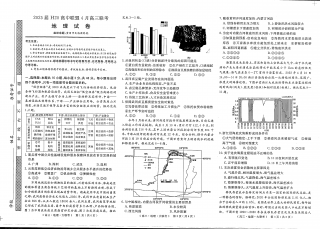
河南省H20高中联盟2024-2025学年高三下学期4月联考试题 地理 PDF版无答案
 2025-05-31 104
作者:envi
分类:分省
价格:3知币
属性:7 页
大小:279.35KB
格式:PDF
时间:2024-11-28
作者详情

相关内容
-
八省八校部分重点中学2025届高三下学期3月联合测评试题(T8联考) 生物 PDF版含解析(河南版)
分类:分省
时间:2025-05-31
标签:无
格式:PDF
价格:3 知币
-
八省八校部分重点中学2025届高三下学期3月联合测评试题(T8联考) 化学 PDF版含解析(河南版)
分类:分省
时间:2025-05-31
标签:无
格式:PDF
价格:3 知币
-
八省八校部分重点中学2025届高三下学期3月联合测评试题(T8联考) 地理 PDF版含解析(河南版)
分类:分省
时间:2025-05-31
标签:无
格式:PDF
价格:3 知币
-
八省八校部分重点中学2025届高三下学期3月联合测评试题(T8联考) 历史 PDF版含解析(河南版)
分类:分省
时间:2025-05-31
标签:无
格式:PDF
价格:3 知币
-
河南省H20高中联盟2024-2025学年高三下学期4月联考试题 地理 PDF版无答案
分类:分省
时间:2025-05-31
标签:无
格式:PDF
价格:3 知币


