
专题06 句型-2022年小升初衔接英语语法过关(全国通用)


句型关(Sentence Patterns)
知识大纲
句型种类 句型特点
1. 陈述句
① 肯定句:主+谓,如-I have two brothers.
② 否定句:
a. 主+谓(助动词 be/have 或情态动词 can/could/might/should 等+not) , 如-
He can't speak English.
b. 主+don't/doesn't/didn't +谓(实意动词), 如-Peter didn't go to school
yesterday.
2. 疑问句
① 一般疑问句:以情态动词/系动词(be) /助动词(do/have) 开头,一般可
用yes/no 回答。
② 特殊疑问句:以 what,who,which,when,how,why,where 开头,一般不可直
接用 yes/no 回答。
③ 选择疑问句:给出两个或以上的答案(通常用 or 连接), 让对方选择
答案。
④ 反意疑问句:结构一“前肯后否,前否后肯”。
3. 祈使句 ① 肯定祈使句
② 否定祈使句
1. 肯定: (Let sb. ) +do sth. (please)
2. 否定:No+doing sth. / Don't+do sth.
4. 感叹句 ①What 开头
②How 开头
1. What+ (a/an) +形容词+名词+ (主语+谓语)!
2. How+形容词/副词+主语+谓语(+其他)!
5. There be
句型
① 肯定陈述句&
否定陈述句
② 疑问句&回答
1. There is/are sth. /There isn't/aren't sth.
2. -Is/Are there sth. ?
-Yes,there is/are. 或
-No,there isn't/aren't.
6. It's 句型 (1). It's+adj. +for/of +sb. +to do sth.
(2). It's time for (doing) / to do sth.
衔接阶段难点
1. 含有情态动词的一般疑问句的回答
(1) Could/Can 表示委婉请求和许可时,不可用 could 回答。
即用 Could/Can 提问时, 一肯定回答:Of course. /Certainly. /Sure. /Yes,you can.
---否定回答:Sorry,you can't.
Grammar
1
(2) 用May 提问时,一肯定回答:Yes,you may/can.
---否定回答:No,you may not/can't/mustn't.
(3) 用 Must 提问时,---肯定回答:Yes, you must.
---否定回答:No,you needn't. 或No,you don't have to.
2. 高频特殊疑问词/句型
① 问时间或日期:When; How long; How soon;
What's the time/date? /What time/day is it? ;
② 问频率:How often;
③ 问数量或价钱:How many (可数); How much (不可数);
④ 问人物或身份、职业:What's sb. ? /What does sb.do? /Who is/are. . . ? ;
⑤ 问方位、地点:Where;
⑥ 问方式:How;
⑦ 问原因:Why;
⑧ 问身体状态或情绪:How do you feel? /How are you?
⑨ 问年龄/身高/体重/距离/长短:How old/tall/heavy/far/long. . . .
10 常考句型:Why not do sth. ? =Why don't you do sth. ? ;
How/What about doing sth. ? =Shall we do sth. ? =Let's do sth.
3. 反意疑问句的问句部分
(1) 陈述句的主语:this/that 或these/those, 问句主语:分别用 it 或they;
(2) There be 句型的问句主语用 there;
(3) 陈述句的主语是指物的不定代词:everything,anything,something,nothing, 问句主语用 it;
(4) 陈述句的主语是指人的不定代词:no one,nobody, someone, everyone, 若问句的主语强
调全体时可用 they, 强调个体时常用 he.
(5) 陈述句为肯定祈使句时,问句用 won't you, 陈述句为否定祈使句时,问句用 will you.
(6) 以Let's 开头的祈使句,问句用 shall we; 以 Let us 开头的祈使句,问句用 will you.
(7) 陈述句含有 little,few,no,nothing,nobody,none,neither,never. hardly,seldom 等表示否定意
义的词时,问句用肯定形式。
4. 同义转化:祈使句和 If 条件状语从句
祈使句:Get up early,and you'll catch the first bus. =Get up early,or you'll not catch the first bus.
If 条件状语从句:If you get up early,you'll catch the first bus.
5. There be 句型:就近原则
即靠近 be 的名词或代词若是单数,be 用 is; 反之用 are.
There is an apple and two bananas on the table.
There are two bananas and an apple on the table.
6. There be 句型:一般将来时的常用表达方式
There will be. . . 或 There is/ are going to be. . . (V)表示“将会有””。。,”
There will have. . . 或 There is/are going to have. . . (x)
注意:
①there be=have, 都表示“有”, 因此为了避免语义重复,一般将来时中,there will 后接 be
2

相关推荐
-
河南省H20高中联盟2024-2025学年高三下学期4月联考试题 物理 PDF版含解析
 2025-05-31 62
 -
河南开封市、周口市、商丘市2025届高三下学期3月第二次质量检测试题 政治 PDF版含答案
 2025-05-31 87
 -
河南开封市、周口市、商丘市2025届高三下学期3月第二次质量检测试题 数学 PDF版含答案
 2025-05-31 62
 -
河南开封市、周口市、商丘市2025届高三下学期3月第二次质量检测试题 地理 PDF版含答案
 2025-05-31 48
 -
八省八校部分重点中学2025届高三下学期3月联合测评试题(T8联考) 政治 PDF版含解析(河南版)
 2025-05-31 41
 -
八省八校部分重点中学2025届高三下学期3月联合测评试题(T8联考) 生物 PDF版含解析(河南版)
 2025-05-31 104
 -
八省八校部分重点中学2025届高三下学期3月联合测评试题(T8联考) 化学 PDF版含解析(河南版)
 2025-05-31 87
 -
八省八校部分重点中学2025届高三下学期3月联合测评试题(T8联考) 地理 PDF版含解析(河南版)
 2025-05-31 75
 -
八省八校部分重点中学2025届高三下学期3月联合测评试题(T8联考) 历史 PDF版含解析(河南版)
 2025-05-31 90
 -
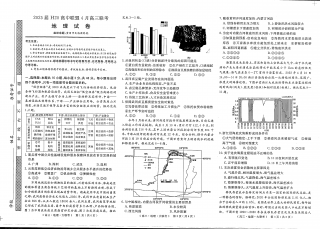
河南省H20高中联盟2024-2025学年高三下学期4月联考试题 地理 PDF版无答案
 2025-05-31 102
作者:envi
分类:初中
价格:3知币
属性:6 页
大小:154KB
格式:DOC
时间:2025-03-28
作者详情

相关内容
-
八省八校部分重点中学2025届高三下学期3月联合测评试题(T8联考) 生物 PDF版含解析(河南版)
分类:分省
时间:2025-05-31
标签:无
格式:PDF
价格:3 知币
-
八省八校部分重点中学2025届高三下学期3月联合测评试题(T8联考) 化学 PDF版含解析(河南版)
分类:分省
时间:2025-05-31
标签:无
格式:PDF
价格:3 知币
-
八省八校部分重点中学2025届高三下学期3月联合测评试题(T8联考) 地理 PDF版含解析(河南版)
分类:分省
时间:2025-05-31
标签:无
格式:PDF
价格:3 知币
-
八省八校部分重点中学2025届高三下学期3月联合测评试题(T8联考) 历史 PDF版含解析(河南版)
分类:分省
时间:2025-05-31
标签:无
格式:PDF
价格:3 知币
-
河南省H20高中联盟2024-2025学年高三下学期4月联考试题 地理 PDF版无答案
分类:分省
时间:2025-05-31
标签:无
格式:PDF
价格:3 知币


