
吉林省通化市梅河口市第五中学2024-2025学年高三上学期12月月考试题 英语 Word版含答案

高三英语 12 月考
第一部分 阅读(共两节,满分 50 分)
第一节(共 15 小题;每小题 2.5 分,满分 37.5 分)
阅读下列短文,从每题所给的 A,B,C,D 四个选项中选出最佳选项。
A
Discover Nature Schools Programs
Becoming Bears(Kindergarten-2 grade)
By becoming baby bears, children learn from their “parent” to survive the seasons. Kids will find safety in the spring and
learn kinds of food bears eat during the summer, and then create a cave for winter hibernation(冬眠).After learning the skills
needed to survive, students will go out of the cave as an independent black bear able to care for themselves.(1.5-2 hours)
Whose Clues?(3-5 grade)
Kids will discover how plants and animals use their special structures to survive. Through outdoor study of plants and
animals, kids will recognize their special structures and learn how they enable species to eat, avoid their enemies and survive.
Using what they have learned, kids will choose one species and tell how they survive in their living places.(3-4 hours)
Winged Wonders(3-5 grade)
Birds add color and sound to our world and play an important ecological role. Students will learn the basics of birds,
understand the role birds play in food chains and go birdwatching using field guides and telescopes. Students will do handson
activities. Students will use tools to build bird feeders, allowing them to attract birds at home.(3-4 hours)
Exploring Your Watershed(6-8 grade)
We all depend on clean water. Examining how our actions shape the waterways around us. Go on a hike to see first hand
some of the challenging water quality problems in a city. Students will test the water quality to determine the health of an
ecosystem.
·Each program is taught for a class with at least 10 students.
·All programs include plenty of time outdoors. So please prepare proper clothing, sunscreen and insect killers for children.
·To take part in a program, please email dcprogramsmdc.mo.gov.
21. What can kids do at Becoming Bears?
A. Watch bears' performances. B. Take care of bears.
C. Learn how to survive a bear attack. D. Pretend to be baby bears to learn about bears.
22. Which one will kids who are interested in plants choose?
A. Whose Clues? B. Exploring Your Watershed
C Becoming Bears D . Winged Wonders
23. What do all the four programs have in common according to the passage?
A. have the same teaching hours B. have outdoor activities
C. are offered during summer holidays D. are designed for primary school students
B
Age has never been a problem for Thessalonika Arzu-Embry. After all, she’s already got her master’s degree.
The North Chicago-area girl started homeschooling at the age of 4. She began having an influence on others soon after.
When she was 6 years old, she was an inspirational speaker at an organization called Tabitha House Community Service, a
shelter for people who were forced to leave their homes due to the situations such as earthquakes, flood and other natural
disasters.
At the age of 11, she graduated from high school and then earned her bachelor’s degree in psychology in 2013. She
completed those classes online as she was traveling for leadership meetings.
She doesn’t stop there, though. The girl plans to take up aviation psychology ( 航空心理学) for her further study, a
decision inspired by her father who is a pilot. She grew up around airplanes and took flights all the time. Her goal is to use it to
determine whether pilots are dealing with problems that could have deadly results once the plane takes off — a topic that has
been in the news lately. For her, it’s a mix of two of her interests.
In her free time, Thessalonika enjoys playing tennis, swimming and being active in her youth group. She also has three
self-published books, which are on her site. Jump the Education Barrier is written to help students finish college, and In the
Future aims to help business owners deal with trends. Her third book The Genius Race has a wider appeal. It is designed to help
.

people to be geniuses in various areas of life.
24. What can we know about Thessalonika from the text?
A. She majored in science and technology.
B. She gained her master’s degree at the age of 11.
C. She started homeschooling when she was 6 years old.
D. She got her bachelor’s degree through online courses.
25. What is Thessalonika’s next plan according to the text?
A. Majoring in aviation psychology.
B. Being active in her youth group.
C. Making inspiring speeches for leadership meetings.
D. Writing another book to help people to be geniuses.
26. Why does Thessalonika write the book Jump the Education Barrier?
A. To raise concern about psychology.
B. To help people to be successful.
C. To give students a hand to complete college.
D. To share her own experience with others.
27. What’s the text mainly about?
A. Homeschooling. B. The way to be a genius.
C. Three published books. D. The story of Thessalonika.
C
Here’s a quick quiz. Person A does a favor for you. Person B asks you to do a favor for him. Who do you tend to like
more? Surprisingly, the answer is Person B. This quirk (怪癖) of human nature is known as the Ben Franklin Effect.
Benjamin Franklin came across the phenomenon in 1736 when serving as a clerk to the Pennsylvania Assembly. A
powerful member didn’t care for Franklin and threatened to make life miserable for him. What to do? Instead of winning him
over with sweet talk, Franklin asked if he could borrow a rare and valuable book the man owned. This request altered the man’s
attitude and paved the way for their friendship. Franklin’s takeaway: “He that has once done you a kindness will be ready to do
you another, than he whom you yourself have obliged.”
Several studies have confirmed this. But how can we explain the Ben Franklin Effect? Some psychologists refer to
cognitive dissonance (失调). It’s difficult to hold two contradictory thoughts at the same time. It makes us uncomfortable. We
resolve this tension by changing our mind. “I don’t like Joe, but I am doing him a favor,” we might think. “So maybe I do like
him.”
While cognitive dissonance explains a lot, it alone doesn’t explain the Ben Franklin Effect. One 2015 study found that it
was, rather, the affiliative (亲和的) motive that the requests convey. That is, we humans want to maintain good relations with
other humans, and one way to achieve this is by doing favors for others. This explains a lot about altruistic behavior. We like
being useful and, by extension, we like those who give us the opportunity to do so. It’s in our genes.
Yet there is much we still don’t know about the Ben Franklin Effect. Does it apply equally across cultures? Is there a point
beyond which asking a favor makes you less, not more likable? Asking to borrow a book is one thing; asking to borrow a car is
another.
28. Why does the author mention Benjamin Franklin’s experience?
A. To illustrate a dilemma in making choices. B. To suggest a way of striking up friendships.
C. To stress the importance of strategic requests. D. To introduce the origin of the Ben Franklin Effect.
29. What is a reason for people’s tendency to like those asking for favors?
A. Reducing the tension caused by social contact.
B. Increasing the chance of getting help in return.
C. Avoiding the discomfort from conflicting thoughts.
D. Establishing a cooperative community of shared trust.
30. What does the underlined word “altruistic” probably mean in paragraph 4?
A. Selfless. B. Impolite. C. Aggressive. D. Responsible.
31. What does the author think of the Ben Franklin Effect?
A. It makes little sense. B. It applies to most cultures.
C. It has situational limitations. D. It has great practical significance.
D
At one time, our growing population was seen as central to wildlife extinction, resource exhaustion, pollution and
environmental destruction. But today, our concerns shift to declining birth rates due to increased reproductive choice for
women.
This is a positive development, but is often described as a “crisis” in the media, highlighting economic and senior care
challenges. Lost in the conversation are the many positive aspects of an aging society, which is the result of people living
healthier and longer lives, and common-sense realities like reduced needs for infrastructure ( 基础设施) and lower ecological
impacts. Also lost is the fact that our population still grows by 80 million people every year.
And the consequences of high birth rates are severe. Among them is global warming. In fact, increased emissions ( 排放)
from population growth have canceled more than three quarters of the emissions saved through energy efficiency and
renewables over the past three decades.
Yet, no matter how well documented the link between population and climate, lowering our population is notably absent
from the conversation on solutions. Instead, the focus is on technology that will supposedly allow our entire growing population
to enjoy the energy-intensive lifestyles now enjoyed by the rich, and with no climate impacts.
But “green” technology is not the solution it is advertised to be. Its expansion to the degree needed to power a growing
population at a decent standard of living would itself require a shocking investment in fossil ( 化 石 ) fuels. It also requires
massive mining operations, many of which take place on the backs of low-wage workers in Africa where it is driving
destruction of rainforests critical to the survival of great apes. Besides, it requires 10 times the land area as fossil fuel plants for
the same amount of energy generated.
When global warming threatens to push billions into unsafe temperatures, it is no time to panic that we are adding fewer to
those billions. In fact, declining birth rates should be cause for celebration as they signify advances in gender equality and a
reduced burden on Earth.
32. What can we learn from paragraph 2?

相关推荐
-
2024届云南三校高三下学期联考备考实用性联考(七)文科综合试卷-高中历史 -2022-2023学年七年级数学下册同步精品课堂(北师大版)
 2025-01-25 48
 -
2024届云南三校高三下学期联考备考实用性联考(七)文科综合试卷-高中地理 含解析-2022-2023学年七年级数学下册同步精品课堂(北师大版)
 2025-01-25 82
 -
2024届云南三校高三下学期联考备考实用性联考(七)理科综合试卷-高中物理 含解析-2022-2023学年七年级数学下册同步精品课堂(北师大版)
 2025-01-25 46
 -
2024届云南三校高三下学期联考备考实用性联考(七)理科综合试卷-高中物理 -2022-2023学年七年级数学下册同步精品课堂(北师大版)
 2025-01-25 67
 -
2024届云南三校高三下学期联考备考实用性联考(七)理科综合试卷-高中生物 含解析-2022-2023学年七年级数学下册同步精品课堂(北师大版)
 2025-01-25 65
 -
2024届云南三校高三下学期联考备考实用性联考(七)理科综合试卷-高中生物 -2022-2023学年七年级数学下册同步精品课堂(北师大版)
 2025-01-25 102
 -
2024届云南三校高三下学期高考备考实用性联考卷(七)英语试卷 含解析-2022-2023学年七年级数学下册同步精品课堂(北师大版)
 2025-01-25 91
 -
2024届云南三校高三下学期高考备考实用性联考卷(七)英语试卷 -2022-2023学年七年级数学下册同步精品课堂(北师大版)
 2025-01-25 95
 -
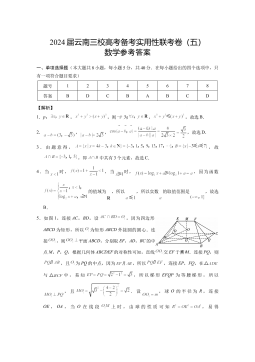
2024届云南三校高考备考实用性联考卷(五)数学-答案和解析-2022-2023学年七年级数学下册同步精品课堂(北师大版)
 2025-01-25 101
 -
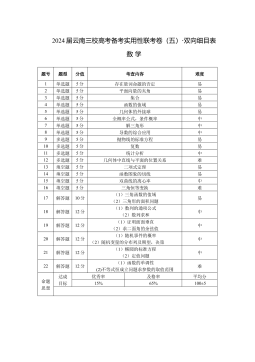
2024届云南三校高考备考实用性联考卷(五)数学 -双向细目表-2022-2023学年七年级数学下册同步精品课堂(北师大版)
 2025-01-25 109
作者:envi
分类:分省
价格:3知币
属性:9 页
大小:33.85KB
格式:DOCX
时间:2024-12-13
作者详情

相关内容
-
2023-2024学年高中上学期期末模拟考试+高一生物期末模拟卷(全国通用,必修1)(答题卡)A4版
分类:高中
时间:2024-12-16
标签:无
格式:DOCX
价格:3 知币
-
2023-2024学年高中上学期期末模拟考试+高一生物期末模拟卷(全国通用,必修1)(A4考试版)【测试范围:必修1】(人教版2019)
分类:高中
时间:2024-12-16
标签:无
格式:DOCX
价格:3 知币
-
2023-2024学年高中上学期期末模拟考试+高一生物期末模拟卷(全国通用,必修1)(A3考试版)【测试范围:必修1】(人教版2019)
分类:高中
时间:2024-12-16
标签:无
格式:DOCX
价格:3 知币
-

(T8联考)2024届高三第一次学业质量评价+生物
分类:高中
时间:2024-12-16
标签:无
格式:PDF
价格:3 知币
-
2023-2024学年高中上学期期末模拟考试+高一生物期末模拟卷(全国通用,必修1)(参考答案)
分类:高中
时间:2024-12-16
标签:无
格式:DOCX
价格:3 知币


