
吉林省普通高中G6教考联盟2023-2024学年高二上学期期末考试 英语 含答案

吉林省普通高中 G6 教考联盟 2023-2024 学年上学期期末考试
高二年级 英语
本试卷共 14 页。考试结束后,将答题卡交回。
注意事项:1.答卷前,考生先将自己的姓名、准考证号码填写清楚,将条形码准确粘贴在考
生信息条形码粘贴区。
2.答题时请按要求用笔。
3.请按照题号顺序在答题卡各题目的答题区域内作答,超出答题区域书写的答案
无效;在草稿纸、试卷上答题无效。
4.作图可先使用铅笔画出,确定后必须用黑色字迹的签字笔描黑。
5.保持卡面清洁,不要折叠,不要弄破、弄皱,不准使用涂改液、修正带、刮纸
刀。
第Ⅰ卷
第一部分:听力(共 20 小题,满分 20 分)
第一节(共 5小题;每小题 1分,满分 5分)
听下面 5 段对话。每段对话后有一个小题,从题中所给的 A、B、C 三个选项中选出最
佳选项。听完每段对话后,你都有 10 秒钟的时间来回答有关小题和阅读下一小题。每段对话
仅读一遍。
1. What is Hailee going to do this afternoon?
A. Take part in an activity.
B. Hang out with Alex.
C. Prepare for an exam.
2. How much should the man pay?
A. $2.10. B. $2.30. C. $3.60.
3. Who is probably the woman?
A. A shop assistant. B. A customer. C. A manager.
4. What does Lily think of eating raw food?
A. Harmful. B. Healthy. C. Strange.
5. Why does the woman move house?
A. For friendly neighbors.
B. For a convenient location.
C. For a comfortable living environment.
第二节(共 15 小题;每小题 1分,满分 15 分)
听下面 5 段对话或独白。每段对话或独白后有几个小题,从题中所给的 A、B、C三个选项中
选出最佳选项,并标在试卷的相应位置。听每段对话或独白前,你将有时间阅读各个小题,每
小题 5 秒钟;听完后,各小题将给出 5 秒钟的作答时间。每段对话或独白读两遍。
听下面一段对话,回答第 6至第 7两个小题。
6. Who accompanied the woman to the hospital?
A. The man. B. Her sister. C. Her mother.
7. What is the woman allergic to?
A. Dust. B. Seafood. C. Mangoes.
听下面一段对话,回答第 8至第 10 三个小题。
8. What is Mr. Foster doing now?
A. Chairing a meeting.
B. Having a meal.
C. Meeting business partners.
9. Why does the woman expect to meet Mr. Foster?
A. To ask for leave.
B. To discuss a project.
C. To make a vacation plan.
10. At what time will the woman see Mr. Foster?
A. 1:00 p.m. B. 1:30 p.m. C. 2:30 p.m.
听下面一段对话,回答第 11 至第 13 三个小题。
11. What does the woman dislike about the black pants?
A. The material. B. The color. C. The style.
12. What color pants does the woman buy?
A. Blue. B. Brown. C. Red.
13. What is the original price of the woman’s purchase?
A. $10. B. $72. C. $80.
听下面一段对话,回答第 14 至第 16 三个小题。
14. How will the man improve his paper?
A. By deleting unnecessary sentences.
B. By adding a couple of points.
C. By correcting grammar mistakes.
15. When should the man submit his paper?
A. Before June 5th.
B. Before June 7th.
C. Before June 12th.
16. What is the woman busy doing?
A. Opening a tea house.
B. Organizing a party.

C. Working on her paper.
听下面一段独白,回答第 17 至第 20 四个小题。
17. How does the speaker feel about memory loss?
A. It’s common.
B. It’s unimportant.
C. It’s worrying.
18. What is the speaker’s first suggestion?
A. Having a good sleep.
B. Doing exercise.
C. Attending social events.
19. How can people stay mentally active?
A. By recalling the past regularly.
B. By taking the same route when driving.
C. By doing crossword puzzles.
20. How many suggestions does the speaker give?
A. Three. B. Four. C. Five.
第二部分 阅读理解(共两节, 满分 50 分)
第一节:(共 20 小题;第 21-31 题,每小题 2.5 分;第 32 题2分;第 33-40 题,每小题 1分。
满分 37.5 分)
阅读下列短文,从每题所给的四个选项(A、B、C、D)中,选出最佳选项。
A
Remembering names is an important social skill. Here are some ways to master it.
Recite and repeat in conversation.
When you hear a person’s name, repeat it. Immediately say it to yourself several times without
moving your lips. You could also repeat the name in a way that does not sound forced or artificial.
Ask the other person to recite and repeat.
You can let other people help you remember their names. After you’ve been introduced to
someone, ask that person to spell the name and pronounce it correctly for you. Most people will be
pleased by the effort you’re making to learn their names.
Admit you don’t know.
Admitting that you can’t remember someone’s name can actually make people relaxed. Most of
them will feel sympathy if you say, “I’m working to remember names better. Yours is right on the tip
of my tongue. What is it again?”
Use associations.
Link each person yon meet with one thing you find interesting or unusual. For example, you
could make a mental note: “Vicki Cheng — tall, black hair.” To reinforce ( 加强) your associations,
write them on a small card as soon as possible.
Limit the number of new names you learn at one time.
When meeting a group of people, concentrate on remembering just two or three names. Free
yourself from remembering every one. Few of the people in mass introductions expect you to
remember their names. Another way is to limit yourself to learning just first names. Last names can
come later.
Go early.
Consider going early to conferences, parties and classes. Sometimes just a few people show up
on time. That’s fewer names for you to remember. And as more people arrive, you can hear them
being introduced to others — an automatic review for you.
21. How will most people feel when you try hard to remember their names?
A. They will be moved. B. They will be annoyed.
C. They will be delighted. D. They will be discouraged.
22. To reinforce the association you made between the person and something interesting, you may
.
A. write them down B. say it to yourself several times
C. go early to parties D. spell and pronounce the name correctly
23. What does the text mainly tell us?
A. Tips on an important social skill.
B. Importance of attending parties.
C. How to make use of associations.
D. How to recite and repeat names.
B
Culture shock is a broad term for a series of personal difficulties that people go through in new
places ant is usually most extreme for those who can not speak the language of the place they have
moved to or for those who aren’t familiar with the social rules. Both of these things applied to me in
China when I moved there in 2011. So, naturally I went through the full well-known stages of culture
shock: the honeymoon, frustration, adjustment and acceptance.
When I arrived I was excited and optimistic but I quickly became annoyed by cultural
differences, missing how things worked back home.
By the end of my first year I had totally lost my self confidence and I became a bit clumsy and
sensitive person and I thought it was China that made me that way.
Then in my second year I started to pick up some language skills and I found fun activities to do
in my spare time. I made great foreign and Chinese friends and later I developed an interest in
Chinese history and culture. Based on the above I learned to consider myself a confident and happy

foreigner.
Today I’m back in the US where I’m pursuing a PhD at university in my hometown. It’s been a
little tough to readjust to the life in my home country. I suffered at first from reverse culture shock,
experiencing the four stages in the opposite order.
I’d complain loudly about the little things like I could no longer shout “ fu wu yuan” to get a
waiter’s attention in a restaurant. But eventually I came to realize that my home had become an
entirely new place when I was away. That, by itself ,was exciting.
24. Which stage of culture shock does paragraph 3 mainly describe?
A. The honeymoon. B. Frustration .
B. Adjustment. D. Acceptance.
25. Which least help the author ease his culture shock in China ?
A. Making local friends.
B. Joining in fun activities.
C. Attending history courses.
D. Learning the Chinese language.
26. What does the underlined word “reverse” mean?
A. exchanging the position completely.
B. changing the previous decision.
C. stopping having a particular position.
D. changing the order of something around.
27. What can we learn about the author according to the last paragraph?
A. He began to feel that life in the US was boring.
B. He wished to call “fu wu yuan” in a restaurant.
C. He was unable to accept American life.
D. He needed to adjust himself to his native life.
C
Macinley Buston was just sixteen years old when she first had the idea to try and protect women
from a modern necessary radiation during breast cancer treatments and now her invention could be a
game changer in the medical field.
Buston whose father works in medical physics has always been interested in science but she only
began researching the harmful side effects of radiation treatments after her father discussed his
experience with ineffective cancer treatments in his work. Since Buston had also recently lost a relative
to breast cancer, she felt inspired to conduct her own research on the subjects. She tried to begin her
medical research by consulting scientific journals but she found their academic terms almost impossible
to understand.
She then turned to the Internet to find videos that taught how to read scientific journals as she went
deeper in her research she stumbled upon a key bit of information: Copper( 铜) has been shown to be
effective at protecting skin from radiation. An idea hit this Australian teen as she was viewing the film
on medieval wars in her tenth grade history class. When she saw the scaled patterns of the mail(盔甲),
she was inspired to create a wearable protective tool out of copper. She then headed back online and
watched the videos on how to put together tiny scales. She made her own flexible scale mail, which she
now calls SMART: Scale Mail For Radiation Therapy.
When her invention was tested in a laboratory setting it reduced a surface exposure to unnecessary
radiation by seventy five per cent and now Buston is working on getting her SMART into clinical
settings for use.
28. Why did Macinley Buston start her research?
A. To assist her father with his work.
B. To save her relative from cancer.
C. To publish some articles in journeys.
D. To protect patients in cancer treatment.
29. What does the underlined phrase “stumbled upon” in paragraph three probably mean?
A. came across B. missed
C. passed on D. required
30. Where Macinley Buston get inspiration for her invention?
A. Videos online. B. Scientific journals.
C. History textbooks. D. Soldiers’ defensive clothes.
31. Which of the following best describes Macinley Buston ?
A. Stubborn. B. Creative.
C. Selfless. D. Considerate.
D
Questions 32-40 are based on Reading Passage D below.
Giving your brain a workout
Mental agility does not have to decline with age, as long as you keep exercising your mind, says Anna
van Praagh.
A. Use your brain and it will grow — it really will. This is the message from neuropsychologist Ian
Robertson, professor of psychology at Trinity College, Dublin and founding director of the
university's Institute of Neuroscience. His book, Puzzler Brain Trainer 90-Day Workout, contains
puzzles which he devised to stretch, sharpen and stimulate the brain. The puzzles, from ‘memory jogs’
to Sudoku to crosswords to number games are all-encompassing, and have been specially formulated
to improve each and every part of the brain, from visual-spatial ability to perception, attention,
memory, numerical agility, problem-solving and language.
B. Professor Robertson has been studying the brain for 57 years, in a career dedicated to changing
and improving the way it works. During this time there has been a remarkable paradigm shift in the
way scientists view the brain, he says. “When I first started teaching and researching, a very

相关推荐
-
2024届云南三校高三下学期联考备考实用性联考(七)文科综合试卷-高中历史 -2022-2023学年七年级数学下册同步精品课堂(北师大版)
 2025-01-25 48
 -
2024届云南三校高三下学期联考备考实用性联考(七)文科综合试卷-高中地理 含解析-2022-2023学年七年级数学下册同步精品课堂(北师大版)
 2025-01-25 82
 -
2024届云南三校高三下学期联考备考实用性联考(七)理科综合试卷-高中物理 含解析-2022-2023学年七年级数学下册同步精品课堂(北师大版)
 2025-01-25 46
 -
2024届云南三校高三下学期联考备考实用性联考(七)理科综合试卷-高中物理 -2022-2023学年七年级数学下册同步精品课堂(北师大版)
 2025-01-25 67
 -
2024届云南三校高三下学期联考备考实用性联考(七)理科综合试卷-高中生物 含解析-2022-2023学年七年级数学下册同步精品课堂(北师大版)
 2025-01-25 65
 -
2024届云南三校高三下学期联考备考实用性联考(七)理科综合试卷-高中生物 -2022-2023学年七年级数学下册同步精品课堂(北师大版)
 2025-01-25 102
 -
2024届云南三校高三下学期高考备考实用性联考卷(七)英语试卷 含解析-2022-2023学年七年级数学下册同步精品课堂(北师大版)
 2025-01-25 91
 -
2024届云南三校高三下学期高考备考实用性联考卷(七)英语试卷 -2022-2023学年七年级数学下册同步精品课堂(北师大版)
 2025-01-25 95
 -
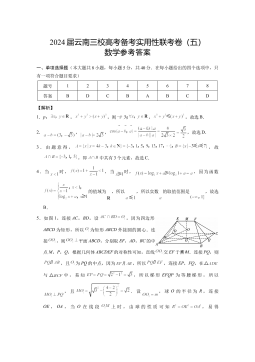
2024届云南三校高考备考实用性联考卷(五)数学-答案和解析-2022-2023学年七年级数学下册同步精品课堂(北师大版)
 2025-01-25 101
 -
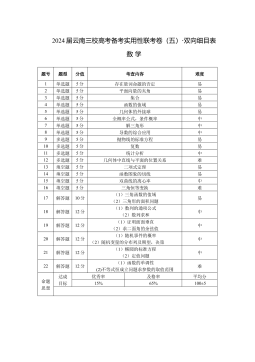
2024届云南三校高考备考实用性联考卷(五)数学 -双向细目表-2022-2023学年七年级数学下册同步精品课堂(北师大版)
 2025-01-25 109
作者:envi
分类:分省
价格:3知币
属性:10 页
大小:69.87KB
格式:DOCX
时间:2025-01-16
作者详情

相关内容
-
2023-2024学年高中上学期期末模拟考试+高一生物期末模拟卷(全国通用,必修1)(答题卡)A4版
分类:高中
时间:2024-12-16
标签:无
格式:DOCX
价格:3 知币
-
2023-2024学年高中上学期期末模拟考试+高一生物期末模拟卷(全国通用,必修1)(A4考试版)【测试范围:必修1】(人教版2019)
分类:高中
时间:2024-12-16
标签:无
格式:DOCX
价格:3 知币
-
2023-2024学年高中上学期期末模拟考试+高一生物期末模拟卷(全国通用,必修1)(A3考试版)【测试范围:必修1】(人教版2019)
分类:高中
时间:2024-12-16
标签:无
格式:DOCX
价格:3 知币
-

(T8联考)2024届高三第一次学业质量评价+生物
分类:高中
时间:2024-12-16
标签:无
格式:PDF
价格:3 知币
-
2023-2024学年高中上学期期末模拟考试+高一生物期末模拟卷(全国通用,必修1)(参考答案)
分类:高中
时间:2024-12-16
标签:无
格式:DOCX
价格:3 知币


