
吉林省长春外国语学校2023-2024学年高一下学期4月月考试题 英语 含答案


长春外国语学校 2023-2024 学年下学期第一次月考
高一年级 英语
出题人 :程静 审题人:陈英卓
注意事项:1. 答卷前,考生先将自己的姓名、准考证号码填写清楚,将条形码准确粘贴在考生
信息条形码粘贴区。
2. 答题时请按要求用笔。
3. 请按照题号顺序在答题卡各题目的答题区域内作答,超出答题区域书写的答案
无效;在草稿纸、试卷上答题无效。
4. 作图可先使用铅笔画出,确定后必须用黑色字迹的签字笔描黑。
5. 保持卡面清洁,不要折叠,不要弄破、弄皱,不准使用涂改液、修正带、刮纸刀。
第一部分 听力(共两节,满分 30 分)
第一节(共 5 小题;每小题 1.5 分,满分 7.5 分)
听下面 5段对话,每段对话后有一个小题,从题中所给的 A、B、C三个选项
中选出最佳选项。听完每段对话后,你都有 10 秒钟的时间来回答有关小题和阅读
下一个小题。每段对话仅读一遍。
1. Which place is the woman leaving for?
A. A shop. B. Jack’s home. C. Her office.
2. What is the weather like now?
A. Rainy. B. Snowy. C. Cloudy.
3. How does the man sound?
A. Embarrassed. B. Grateful. C. Nervous.
4. How will the speakers probably travel?
A. By car. B. By plane. C. By train.
5. What are the speakers mainly talking about?
A. Traffic accidents. B. Sci-fi movies. C. Flying ambulances.
第二节(共 15 小题;每小题 1.5 分,满分 22.5 分)
听下面 5段对话或独白,每段对话或独白后有几个小题,从题中所给的
A、B、C三个选项中选出最佳选项。听每段对话或独白前,你将有时间阅读各个
小题,每小题 5秒钟;听完后,各小题将给出 5秒钟的作答时间。每段对话或独
白读两遍。
听第 6段材料,回答第 6、7题。
6. When will Mary’s rent be due?
A. On February 19. B. On February 20. C. On February 21.
7. What are the speakers going to do about thirty minutes later?
A. Call the man’s cousin.
B. Attend a meeting.
C. Search for an apartment.
听第 7段材料,回答第 8、9题。
8. What does the woman suggest the man do?
A. Travel together.
B. Look for a job.
C. Receive further education.
9. What is the probable relationship between the speakers?
A. Neighbors. B. Co-workers. C. Former schoolmates.
听第 8段材料,回答第 10 至12 题。
10. When did the earthquake happen?
A. On Wednesday night.
B. On Thursday morning.
C. On Thursday afternoon.

11. What damage did the earthquake cause?
A. Forty people lost their lives.
B. At least 140 people were injured.
C. A railway was nearly destroyed.
12. What will the man do next?
A. Help the victims. B. Tell some survival skills. C. Check the highways.
听第 9段材料,回答第 13 至16 题。
13. Which assignment has the man finished?
A. The one on Future Education.
B. The one on Education Psychology.
C. The one on Classroom Approaches.
14. What is the second part of the man’s finished paper about?
A. Testing systems.
B. Teacher training.
C. Rewards and punishments.
15. How does the man support his conclusion?
A. By making comparisons.
B. By giving examples.
C. By doing surveys.
16. What is the man’s attitude to online learning at home for children?
A. Disapproving. B. Uncertain. C. Supportive.
听第 10 段材料,回答第 17 至20 题。
17. What has Barty decided to do at age 25?
A. Retire from tennis. B. Go to college. C. Enter a new
contest.
18. Who is Casey Dellacqua?
A. Barty’s main opponent.
B. Barty’s personal trainer.
C. Barty’s former partner.
19. How old was Barty when she became a professional tennis player?
A. 12. B. 14. C. 16.
20. Which match did Barty win in 2022?
A. British Open. B. French Open. C. Australian Open.
第二部分 阅读理解(共两节, 满分 50 分)
第一节(共 15 小题;每小题 2.5 分,满分 37.5 分)
阅读下列短文,从每题所给的四个选项(A、B、C、D)中,选出最佳选项。
A
The year 2023 witnessed the occurrence of significant cultural events, with culture
and tourism becoming even more closely connected. Let’s review the major cultural
events of 2023 as we bid farewell to the year and embrace the new year of 2024!
Museum visits rise in popularity in summer
Tourists were seen queuing for long hours in front of museums and obtaining
entrance tickets became more challenging. In response to the growing demand, 46
museums in Beijing canceled their customary Monday closures and remained open daily
until August 31. The rise in “museum fever” can be credited to various factors, including
the public’s increasing enthusiasm for traditional Chinese culture, the booming market
for youth educational tours and summer camps, as well as the continuous innovation of
museums.
Old tea forests in Pu’er win World Heritage Site title
The newly named heritage site, located in Lancang Lahu autonomous county in
Pu’er, Yunnan province, consists of five large-scale, well-preserved old tea forests, which
stand 1,250 to 1,500 meters above the sea level, three protective barrier forests, and nine
ancient villages in the old tea forests, which are mainly inhabited by Blang and Dai

ethnic groups. The cultural landscape was jointly created by the ancestors of the Blang
people—who immigrated to the Jingmai Mountain in the 10th century AD and later
discovered and domesticated wild tea trees—and the native Dai people.
Protection plan released for Beijing’s Central Axis
The plan is said to be one of the necessary steps toward bidding for UNESCO World
Heritage status. Alongside regulations on the protection of the Central Axis carried out
earlier, the plan is in line with the requirements of World Heritage conservation. The 21
member countries of the World Heritage Committee will decide on whether Beijing’s
Central Axis can be added to the World Heritage List at the committee’s 46th annual
conference in 2024. If the application succeeds, it will reinforce Beijing’s top position
among cities worldwide by the number of World Heritage Sites.
21. Which of the following is NOT the reason for the rise in “museum fever”?
A. Museums’ ceaseless innovation.
B. The constant innovation of summer camps.
C. The growing market for youth educational tours.
D. People’s growing passion for traditional Chinese culture.
22. Which of the following statements is TRUE concerning the cultural events?
A. 46 museums in Beijing stayed open all year round.
B. The Blang people are the natives in Jingmai Mountain.
C. The heritage site in Pu’er consists of four large old tea forests.
D. Beijing’s Central Axis hasn’t been added to the World Heritage List yet.
23. In which magazine would a reader most likely find this text?
A. Chinese Culture Research B. Scientific Exploration
C. Wonders of the Natural World D. Art and Architecture
B
When Stanford University student Ellen Xu was a five-year-old in California, she
vividly recalls her parents rushing her little sister to the hospital. Three-year-old Kate had
fallen acutely ill; she had a fever, reddened eyes, a rash and some swelling in her hands
and tongue.
At first, the puzzled doctors thought she had influenza, but when her condition didn’t
improve, the Xus returned to the emergency room, where a doctor by chance had prior
experience with an acute inflammatory(炎症性的) reaction in the blood vessels known as
Kawasaki disease(川崎病). Though rare, it’s the leading cause of acquired heart disease
in babies and young children, and its cause and triggers remain somewhat mysterious.
The doctor knew how to treat it: He ordered a dose of intravenous immunoglobulin(静脉
免疫球蛋白), and eventually Kate shook off the illness without suffering damage to her
heart.
Xu remembers being curious about her sister’s dramatic condition and was amazed
that the grown-ups couldn’t answer her questions about why it was so hard to detect. “In
my mind, it was a mystery,” she says. “It was a puzzle I wanted to solve.”
A decade later, wanting to enter a high school science fair, she had an idea: “What if
we had a doctor in our pocket?” So she created just that: Using AI, Xu designed an
algorithm(算法) that uses visual data to diagnose(诊断) Kawasaki disease based on five
physical symptoms.
The technology works the same way as apps that can identify birds and plants with
photos you’ve taken on your cell phone. Worried parents can upload a photo that they
have taken of their child, and the technology will scan the image for symptoms of
Kawasaki disease, which often have a strong visual element, such as a rash or a swollen
tongue.
Xu’s invention has been applied as a web app on the Kawasaki Disease Foundation’s
website without charge. The technology could also be developed for recognizing auto-
immune and rheumatological(风湿病学的) diseases. She says, “It means a lot to me. I
want to use AI to help people live happier and healthier lives.”
24. Why was Kawasaki disease so hard to diagnose?

相关推荐
-
2024届云南三校高三下学期联考备考实用性联考(七)文科综合试卷-高中历史 -2022-2023学年七年级数学下册同步精品课堂(北师大版)
 2025-01-25 48
 -
2024届云南三校高三下学期联考备考实用性联考(七)文科综合试卷-高中地理 含解析-2022-2023学年七年级数学下册同步精品课堂(北师大版)
 2025-01-25 82
 -
2024届云南三校高三下学期联考备考实用性联考(七)理科综合试卷-高中物理 含解析-2022-2023学年七年级数学下册同步精品课堂(北师大版)
 2025-01-25 46
 -
2024届云南三校高三下学期联考备考实用性联考(七)理科综合试卷-高中物理 -2022-2023学年七年级数学下册同步精品课堂(北师大版)
 2025-01-25 67
 -
2024届云南三校高三下学期联考备考实用性联考(七)理科综合试卷-高中生物 含解析-2022-2023学年七年级数学下册同步精品课堂(北师大版)
 2025-01-25 64
 -
2024届云南三校高三下学期联考备考实用性联考(七)理科综合试卷-高中生物 -2022-2023学年七年级数学下册同步精品课堂(北师大版)
 2025-01-25 102
 -
2024届云南三校高三下学期高考备考实用性联考卷(七)英语试卷 含解析-2022-2023学年七年级数学下册同步精品课堂(北师大版)
 2025-01-25 91
 -
2024届云南三校高三下学期高考备考实用性联考卷(七)英语试卷 -2022-2023学年七年级数学下册同步精品课堂(北师大版)
 2025-01-25 95
 -
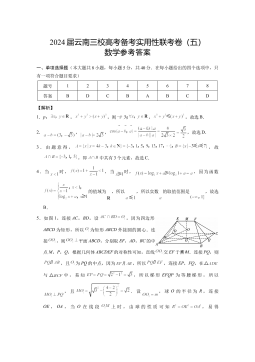
2024届云南三校高考备考实用性联考卷(五)数学-答案和解析-2022-2023学年七年级数学下册同步精品课堂(北师大版)
 2025-01-25 101
 -
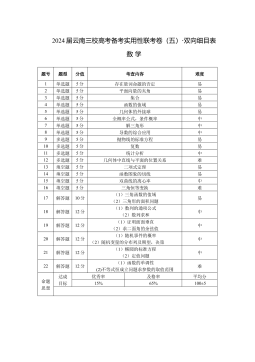
2024届云南三校高考备考实用性联考卷(五)数学 -双向细目表-2022-2023学年七年级数学下册同步精品课堂(北师大版)
 2025-01-25 109
作者:envi
分类:分省
价格:3知币
属性:9 页
大小:81.81KB
格式:DOCX
时间:2025-01-16
作者详情

相关内容
-
2023-2024学年高中上学期期末模拟考试+高一生物期末模拟卷(全国通用,必修1)(答题卡)A4版
分类:高中
时间:2024-12-16
标签:无
格式:DOCX
价格:3 知币
-
2023-2024学年高中上学期期末模拟考试+高一生物期末模拟卷(全国通用,必修1)(A4考试版)【测试范围:必修1】(人教版2019)
分类:高中
时间:2024-12-16
标签:无
格式:DOCX
价格:3 知币
-
2023-2024学年高中上学期期末模拟考试+高一生物期末模拟卷(全国通用,必修1)(A3考试版)【测试范围:必修1】(人教版2019)
分类:高中
时间:2024-12-16
标签:无
格式:DOCX
价格:3 知币
-

(T8联考)2024届高三第一次学业质量评价+生物
分类:高中
时间:2024-12-16
标签:无
格式:PDF
价格:3 知币
-
2023-2024学年高中上学期期末模拟考试+高一生物期末模拟卷(全国通用,必修1)(参考答案)
分类:高中
时间:2024-12-16
标签:无
格式:DOCX
价格:3 知币


