
河南省顶级名校2022届高三考前真题重组导向卷(三)英语试题含答案

2022 届高三考前真题重组导向卷(三)
英语试卷
注意事项:
1.本试卷共 12 页。时间 120 分钟,满分 150 分。答卷前,考生务必将自己的姓名、准考证号填写
在答题卡上。
2.作答时,将答案写在答题卡上。写在本试卷上无效。
3.考试结束后,将本试卷和答题卡一并交回。第一部分 听力(共两节,满分 30 分)
第一节 (共 5小题;每小题 1.5分,满分 7.5分)
听下面 5段对话。每段对话后有一个小题,从题中所给的 A、B、C三个选项中选出最佳选项。听完
每段对话后,你都有 10 秒钟的时间来回答有关小题和阅读下一小题。每段对话仅读一遍。
例:How much is the shirt?
A. £19. 15. B. £9. 18. C. £9. 15.
答案是 C。
1. What does the woman offer to do for the man?
A. Look at his X-ray.
B. Give him some treatment.
C. Help him go to the hospital.
2. What does the woman think of the price?
A. Rather low. B. Quite high. C. Reasonable.
3. What is the woman going to do?
A. Call Julian Assange.
B. Read the news in a paper.
C. Get information on the Internet.
4. Why didn’t the man finish his science homework?
A. He didn’t have enough time.
B. He forgot it completely. C. He found it difficult.
5. What does the job require?
A. Business trips to Italy. B. Excellent Spanish. C. Native Germans.
第二节 (共 15 小题;每小题 1.5分,满分 22.5分)
听下面 5段对话或独白。每段对话或独白后有几个小题,从题中所给的 A、B、C三个选项中选出最
佳选项。听每段对话或独白前,你将有时间阅读各个小题,每小题 5秒钟;听完后,各小题将给出 5
秒钟的作答时间。每段对话或独白读两遍。
听第 6段材料,回答第 6、7题。
6. What lesson will the man give this afternoon?
A. English history. B. English Grammar. C. American history.
7. What time does the conversation take place?
A. At about 6:55. B. At about 7:05. C. At about 7:15.
听第 7段材料,回答第 8至10 题。
8. Where was the woman born?
A. In France. B. In America. C. In England.
9. Who is the art show held by?
A. The man. B. The man’s students. C. The man’s daughter.
10. What do we know about the man’s daughter?
A. She is studying in England.
B. She likes painting and playing the piano.
C. She graduated from New York University.
听第 8段材料,回答第 11 至13 题。
11. How can parents prevent children from falling down the stairs?
A. By using mats. B. By fitting safety gates. C. By accompanying them.
12. Which place is the most dangerous according to the woman?
A. The kitchen. B. The bathroom. C. The living room.
13. What is probably the man?
A. A writer. B. A health adviser. C. A radio host.
听第 9段材料,回答第 14 至16 题。
14. Why was the woman in Japan?
A. To do work there. B. To visit her family. C. To further her study.
15. How was the man’s plan to open his own business in the end?
A. He carried it out smoothly.
B. He improved it. C. He gave it up.
16. What does the woman suggest the man do in the end?
A. Keep in contact. B. Have lunch together. C. Stay at his old job.
听第 10 段材料,回答第 17 至20 题。
17. What place did the Mary Celeste depart from?
A. Italy. B. The USA. C. Greece.
18. When was the Mary Celeste found in the eastern Atlantic 600 miles from Gibraltar?
A. In October, 1872. B. In November, 1872. C. In December, 1872.
19. Why did the ten people leave the ship?
A. The ship was sinking.
B. The ship was badly damaged.
C. Nobody knows the real reason.
20. What was also gone besides the ten people?
A. The alcohol. B. A lifeboat. C. A survival suit.
第二部分 阅读理解(共两节,满分 40 分)
第一节 (共 15 小题;每小题 2分,满分 30 分)
阅读下列短文,从每题所给的 A、B、C和D四个选项中,选出最佳选项。
A
If you ever get the impression that your dog can "tell" whether you look content or annoyed, you may be
onto something. Dogs may indeed be able to distinguish between happy and angry human faces, according to a
new study.
Researchers trained a group of 11 dogs to distinguish between images(图像)of the same person making
either a happy or an angry face. During the training stage, each dog was shown only the upper half or the lower
half of the person’s face. The researchers then tested the dogs’ ability to distinguish between human facial
expressions by showing them the other half of the person’s face or images totally different from the ones used
in training. The researchers found that the dogs were able to pick the angry or happy face by touching a picture
of it with their noses more often than one would expect by random chance.
The study showed the animals had figured out how to apply what they learned about human faces during
training to new faces in the testing stage. "We can rule out that the dogs simply distinguish between the
pictures based on a simple cue, such as the sight of teeth," said study author Corsin Muller. "Instead, our results
suggest that the successful dogs realized that a smiling mouth means the same thing as smiling eyes, and the
same rule applies to an angry mouth having the same meaning as angry eyes.”
"With our study, we think we can now confidently conclude that at least some dogs can distinguish human
facial expressions," Muller told Live Science.
At this point, it is not clear why dogs seem to be equipped with the ability to recognize different facial
expressions in humans. "To us, the most likely explanation appears to be that the basis lies in their living with
humans, which gives them a lot of exposure to human facial expressions," and this exposure has provided them
with many chances to learn to distinguish between them, Muller said.
21. The new study focused on whether dogs can_________.
A. distinguish shapes B. make sense of human faces
C. feel happy or angry D. communicate with each other
22. What can we learn about the study from paragraph 2?
A. Researchers tested the dogs in random order.
B. Diverse methods were adopted during training.
C. Pictures used in the two stages were different
D. The dogs were photographed before the test.
23. What is the last paragraph mainly about?
A. A suggestion for future studies. B. A possible reason for the study findings.
C. A major limitation of the study D.An explanation of the research methods.
B
Who is a genius? This question has greatly interested humankind for centuries.
Let’s state clearly: Einstein was a genius. His face is almost the international symbol for genius. But we
want to go beyond one man and explore the nature of genius itself. Why is it that some people are so much
more intelligent or creative than the rest of us? And who are they?
In the sciences and arts, those praised as geniuses were most often white men, of European origin. Perhaps
this is not a surprise. It’s said that history is written by the victors, and those victors set the standards for
admission to the genius club. When contributions were made by geniuses outside the club — women, or people
of a different color or belief — they were unacknowledged and rejected by others.
A study recently published by Science found that as young as age six, girls are less likely than boys to say
that members of their gender are “really, really smart.” Even worse, the study found that girls act on that belief:
Around age six they start to avoid activities said to be for children who are “really, really smart.” Can our
planet afford to have any great thinkers become discouraged and give up? It doesn’t take a genius to know the
answer: absolutely not.
Here’s the good news. In a wired world with constant global communication, we’re all positioned to see
flashes of genius wherever they appear. And the more we look, the more we will see that social factors like
gender, race, and class do not determine the appearance of genius. As a writer says, future geniuses come from
those with “intelligence, creativity, perseverance, and simple good fortune, who are able to change the world."
24. What does the author think of victors’ standards for joining the genius club?
A. They’re unfair. B. They’re conservative.
C. They’re objective. D. They’re strict.
25. What can we infer about girls from the study in Science?
A. They think themselves smart.
B. They look up to great thinkers.
C. They see gender differences earlier than boys.
D. They are likely to be influenced by social beliefs.
26. Why are more geniuses known to the public?
A. Improved global communication.
B. Less discrimination against women.
C. Acceptance of victors’ concepts.
D. Changes in people’s social positions.
27. What is the best title for the text?
A. Geniuses Think Alike B. Genius Takes Many Forms
C. Genius and Intelligence D. Genius and Luck
C
Art is everywhere. Any public space has been carefully designed by an artistic mind to be both functional
and beautiful. Why, then, is art still so widely considered to be "the easy subject" at school, insignificant to
wider society, a waste of time and effort?
Art can connect culture with commercial products in a way that not many other things can; art generates
money and holds significant emotional and cultural value within communities. When people attend a concert,
they are paying for music, sure, maybe even hotel rooms, meals, and transport, but they also gain an incredible
experience, a unique atmosphere and a memory that will go through the rest of their lives. People don't just
want material things anymore, they want to experience life 一the arts are a perfect crossover (交迭)between
culture and commerce.
Furthermore, the arts can bring communities together, reducing loneliness and making people feel safer.
Social bonds are created among individuals when they share their arts experiences through reflection and
discussion, and their expression of common values through artworks in honour of events significant to a
nation's experience.
The arts clearly have a pretty positive impact on physical and psychological health. It is found that people
who frequent cultural places or participate in artistic events are more likely to gain good health compared to
those who do not; more engagement with the arts is linked to a higher level of people's well-being. The Royal
Society of Public Health discovered that music and art, when used in hospitals, help to improve the conditions
of patients by reducing stress, anxiety and blood pressure.
Children who are involved with the arts make greater achievements in their education: those engaged with
drama have greater literary ability while others taking part in musical practice exhibit greater skills in math and
languages. Kids with preference for the arts have a greater chance of finding employment in the future.

Participating in the arts is essential for child development; encouraging children to express themselves in
constructive ways could help to form healthy emotional responses in later life.
Vital to human life, art is celebrated and used by nations across the world for various purposes. Life
without art would be boring and dead still, for art is a part of what makes us human.
28. Art products differ from most other commercial products because _____________.
A. most people purchase them for collection
B. they are more expensive and less accessible
C. they have both commercial and cultural values
D. their prices may climb up as time passes
29. By sharing their arts experiences, community members can _____________.
A. keep the community safe from illnesses
B. develop a stronger tie between them
C. learn to appreciate their own works of art
D. offer honourable solutions to their problems
30. What can we learn about people who are involved in artistic activities?
A. They enjoy better living conditions.
B. They like to compare themselves with others.
C. They are particularly good at both music and art.
D. They tend to be healthier physically and mentally.
31. What is the best title for this passage?
A. How Art Cures Our Hearts
B. Art: A Blessing to Humankind
C. How Art Benefits Communities
D. Art: A Bridge Between Cultures
D
Popularization has in some cases changed the original meaning of emotional intelligence. Many people no
w misunderstand emotional intelligence as almost everything desirable in a person’s makeup that cannot be me
asured by an IQ test, such as character, motivation, confidence, mental stability, optimism and “people skills.”
Research has shown that emotional skills may contribute to some of these qualities, but most of them move far
beyond skill-based emotional intelligence.
We prefer to describe emotional intelligence as a specific set of skills that can be used for either good or
bad purposes. The ability to accurately understand how others are feeling may be used by a doctor to find how
best to help her patients, while a cheater might use it to control potential victims. Being emotionally intelligent
does not necessarily make one a moral person.
Although popular beliefs regarding emotional intelligence run far ahead of what research can reasonably
support, the overall effects of the publicity have been more beneficial than harmful. The most positive aspect of
this popularization is a new and much needed emphasis(重视) on emotion by employers, educators and others
interested in promoting social well-being. The popularization of emotional intelligence has helped both the
public and researchers re-evaluate the functionality of emotions and how they serve people adaptively in
everyday life.
Although the continuing popular appeal of emotional intelligence is desirable, we hope that such attention
will excite a greater interest in the scientific and scholarly study of emotion. It is our hope that in coming
decades,advances in science will offer new perspectives(视角) from which to study how people manage their
lives. Emotional intelligence, with its focus on both head and heart, may serve to point us in the right direction.
32. What is a common misunderstanding of emotional intelligence?
A. It can be measured by an IQ test.
B. It helps to exercise a person’s mind.
C. It includes a set of emotional skills.
D. It refers to a person’s positive qualities.
33. Why does the author mention “doctor” and “cheater” in paragraph 2?
A. To explain a rule. B. To clarify a concept
C. To present a fact. D. To make a prediction.
34. What is the author’s attitude to the popularization of emotional intelligence?
A. Favorable. B. Intolerant.
C. Doubtful. D. Unclear.
35. What does the last paragraph mainly talk about concerning emotional intelligence?
A. Its appeal to the public.
B. Expectations for future studies.
C. Its practical application.
D. Scientists with new perspectives.
第二节 (共 5小题;每小题 2分,满分 10 分)
根据短文内容,从短文后的选项中选出能填入空白处的最佳选项。选项中有两项为多余选项。
Some individuals are born with a gift for public speaking.36 Do you want to be a good public speaker?
Here are some principles you must master.
People want to listen to someone who is interesting, relaxed and comfortable. Too often when you stand
up to give a speech, you focus on the “public”at the expense of the”speaking.” 37 Focus on the speaking. Talk
directly to your audience, be yourself and make a connection.
Even the most successful public speaker will make mistakes. Yet, the only one who cares about any
mistake is the one who is speaking. People’s attention wanders constantly. In fact,most people only absorb
about 20 percent of a speaker’s message. So, don’t stop speaking when you make a mistake unless it’s a truly
serious one. 38
Your goal is not to be a perfect public speaker. 39 And like everything else in life, that takes practice.
Remember, even world champion athletes practice their skills on a consistent basis.
40 It’s rare to hear someone say, “I wish that speaker had spoken longer. “On the other hand, you
probably can’t count the times that you’ve thought, “I’m glad that talk is over. It seemed to go on forever! “So
surprise your audience. Always make your presentation just a bit shorter than anticipated. It’s better to leave
your listeners wishing for more than shifting restlessly in their seats waiting for your speech finally to end.
A.Do the opposite.
B.You want to be an effective public speaker.
C.You don’ t need to apologize for a minor slip.
D.When it comes to public speaking, less is usually more.
E.The objective of most speeches is to benefit the audience.

相关推荐
-
2024届云南三校高三下学期联考备考实用性联考(七)文科综合试卷-高中历史 -2022-2023学年七年级数学下册同步精品课堂(北师大版)
 2025-01-25 48
 -
2024届云南三校高三下学期联考备考实用性联考(七)文科综合试卷-高中地理 含解析-2022-2023学年七年级数学下册同步精品课堂(北师大版)
 2025-01-25 81
 -
2024届云南三校高三下学期联考备考实用性联考(七)理科综合试卷-高中物理 含解析-2022-2023学年七年级数学下册同步精品课堂(北师大版)
 2025-01-25 45
 -
2024届云南三校高三下学期联考备考实用性联考(七)理科综合试卷-高中物理 -2022-2023学年七年级数学下册同步精品课堂(北师大版)
 2025-01-25 66
 -
2024届云南三校高三下学期联考备考实用性联考(七)理科综合试卷-高中生物 含解析-2022-2023学年七年级数学下册同步精品课堂(北师大版)
 2025-01-25 63
 -
2024届云南三校高三下学期联考备考实用性联考(七)理科综合试卷-高中生物 -2022-2023学年七年级数学下册同步精品课堂(北师大版)
 2025-01-25 102
 -
2024届云南三校高三下学期高考备考实用性联考卷(七)英语试卷 含解析-2022-2023学年七年级数学下册同步精品课堂(北师大版)
 2025-01-25 90
 -
2024届云南三校高三下学期高考备考实用性联考卷(七)英语试卷 -2022-2023学年七年级数学下册同步精品课堂(北师大版)
 2025-01-25 95
 -
2024届云南三校高考备考实用性联考卷(五)数学-答案和解析-2022-2023学年七年级数学下册同步精品课堂(北师大版)
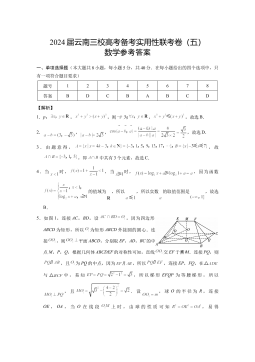 2025-01-25 101
 -
2024届云南三校高考备考实用性联考卷(五)数学 -双向细目表-2022-2023学年七年级数学下册同步精品课堂(北师大版)
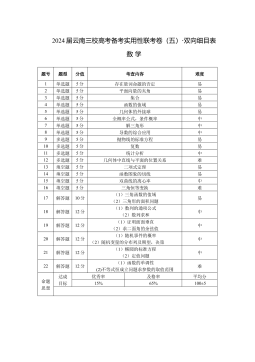 2025-01-25 109
作者:envi
分类:分省
价格:3知币
属性:7 页
大小:301.02KB
格式:DOCX
时间:2024-09-25
作者详情

相关内容
-
2023-2024学年高中上学期期末模拟考试+高一生物期末模拟卷(全国通用,必修1)(答题卡)A4版
分类:高中
时间:2024-12-16
标签:无
格式:DOCX
价格:3 知币
-
2023-2024学年高中上学期期末模拟考试+高一生物期末模拟卷(全国通用,必修1)(A4考试版)【测试范围:必修1】(人教版2019)
分类:高中
时间:2024-12-16
标签:无
格式:DOCX
价格:3 知币
-
2023-2024学年高中上学期期末模拟考试+高一生物期末模拟卷(全国通用,必修1)(A3考试版)【测试范围:必修1】(人教版2019)
分类:高中
时间:2024-12-16
标签:无
格式:DOCX
价格:3 知币
-

(T8联考)2024届高三第一次学业质量评价+生物
分类:高中
时间:2024-12-16
标签:无
格式:PDF
价格:3 知币
-
2023-2024学年高中上学期期末模拟考试+高一生物期末模拟卷(全国通用,必修1)(参考答案)
分类:高中
时间:2024-12-16
标签:无
格式:DOCX
价格:3 知币


