
吉林省长春市实验中学2023-2024学年高一上学期12月期中考试+英语+含答案


团结 勤奋 求实 创新
长春市实验中学
2023-2024 学年上学期期中试卷
高一英语试卷
一、选词填空-句子(本大题共 1小题,共 15 分)
1.On my way home, traffic was held up in front of the University stadium-it is a busy area (1) I saw a young
woman trying (2) ( get) a tiny (maybe 8 weeks old) cat out of (3) road. The kitten (小猫) (4) (
terrify) and she finally got the little one but dropped him. The kitten ran to the roadside and lay there in shock.
I pulled over and got out as she had gone back into her truck (maybe since the kitty was out of the road her part
was done) and (5) (simple) took him to safety.
As I was doing so, two beautiful young men pulled over and asked if I needed help. Well,I said,maybe. I
showed them the kitten and put him (6) the cab of their truck. They were instantly in love. They also knew
where the (7) ( shelter) were in town.
I told them I could take the kitten to one if they couldn't, but they told me they would take the kitten and if they
didn't keep him, they would take him to a shelter. As I left, I heard one say, "kittens deserve (8) ( well)
than this." There (9) ( be) some truly wonderful young people out there. My heart broke with (10) (
happy) to see these guys caring so obviously.
二、阅读理解(本大题共 20 小题,共 45 分)
A
Far, far below your feet lies a source of nearly endless energy. Earth's core is about as hot as the surface of the
Sun, so hot that it melts the rocky layers above it into magma, or liquid rock. Wouldn't it be great if we could tap
into all that energy? In some places, we do!
The Geysers is an area north of San Francisco in California where magma's heat turns a reservoir of underground
water into steam. This region is home to 18 geothermal power plants. The steam rises up through spaces between
the rocks underground, a bit like how steam pours from a teakettle boiling on a stove. The power plant has
pipelines that send the steam into the turbines (涡轮机) where electricity flow is generated. Once the steam leaves
the turbine, it goes into a cooling tower where it turns back into liquid. Then it's piped back into the reservoir to be
reheated again. Other kinds of geothermal power plants pump hot groundwater into the power plant. Then the
pressure is reduced, causing the liquid to flash into steam that turns the turbine and generates electricity flow. Once
the steam cools and turns back into liquid, it's pumped back down into the reservoir to begin the cycle again.
So why don't we all heat our homes with free steam from the earth? First, the heat has to be close enough to the
surface for us to reach it. Next, there has to be plenty of underground water to be heated. Finally, there has to be a
layer of rock that water or steam can flow through. So in places where all three of those things come together,
geothermal energy can be a powerful renewable energy source. Besides, when a geothermal plant returns water
back into the hot rocks of a reservoir, it makes the rock crack a bit, which can cause small earthquakes. There's
another danger that comes with drilling near magma-pipes and other equipment might melt if they hit a pocket of
magma or are caught in an eruption. One geothermal plant in Hawaii was partially buried by lava in 2018. But
engineers are hopeful that the repaired plant will generate even more power. Geothermal energy isn't the answer for
everywhere, but it's a piece of the puzzle to help slow climate change.
2.In which part of power plants is the electricity made?
A. The turbine. B. The reservoir. C. The pipeline. D. The tower.
3.What prevents free steam from being widely developed according to paragraph 3?
A. Hard surface and possible earthquakes.
B. Changeable climate and unqualified equipment.
C. Limited underground water and thin layers of rock.
D. Unsuitable geological conditions and potential dangers.
4.Why is the buried geothermal plant in Hawaii mentioned?
A. To demonstrate the great effort that engineers made.
B. To show the power that the repaired plant can generate.
C. To illustrate the danger caused by drilling near magma.
D. To praise the engineers who repaired the generate plant.
5.What is the author's attitude towards geothermal energy?
A. Unconcerned. B. Unclear. C. Doubtful. D. Approving.
B
Biological fieldwork can mean trips to exotic places. The most common method is to send a few eager graduate
students armed with camera traps and several weeks of spare time. But perhaps not for much longer. A paper
published in Current Biology suggests an easier method: simply swabbing(擦拭) nearby leaves for DNA.
The DNA in question is called "environmental DNA" (eDNA for short). It refers to all the genetic information
that animals leave behind as they go about their daily business: breathing, urinating, or interacting with their
environment in any way. In recent years, genesequencing(基因测序) technology has become quick and sensitive
enough to pick out genetic sequences from particular animals including humans from this eDNA.
One way of doing so is simply to blow air through filters(过滤器), and then analyse them to see which animals
live nearby. Drs Gogarten and Lynggaard wondered if there might be a simpler approach. Air-sampling systems
can take days to do their work. Maintenance must be done, and filters must be changed. But given that eDNA is
literally blowing around ecosystems, the searchers wondered if it might be collecting on leaves.
The leaves of many plants are waxy(蜡质的) and somewhat sticky. The researchers theorised that eDNA might
end up stuck to leaves and that it could subsequently be collected by swabbing them. They tested their theory in the
dense rain forests of Kibale National Park, in Uganda. Using simple cotton swabs, and wearing masks and gloves
to prevent polluting the samples with their own DNA, they visited three areas of the park and collected eight swabs
at each site, and then took them back to Copenhagen for analysis.
The swabs revealed the presence of 26 birds, 24 mammals, one amphibian and one fish, with each swab
containing DNA from eight animals on average. More than half the samples were good enough to work out the
precise species they came from.
Swabbing for animals, then, seems to work. Moreover, it is cheap, easy and fast. Graduate students will have to
be content spending less time sample-hunting in distant parts of the world.
6.Who will benefit most from the research findings?
A. Forest farmers. B. Biological graduates.
C. Ambitious scientists. D. Environmental activists.
7.Why was the researchers armed with masks and gloves?
A. To protect the leaves. B. To avoid getting stuck.
C. To stay safe from wax. D. To ensure the quality of samples.
8.How is eDNA method compared with the common ways?
A. More animal-friendly. B. Free of complex analysis.
C. More accurate and effective. D. Economical in time and money.
9.What serves as the best title for the text?
A. Swabbing leaves: an easier method to track animals
B. Testing eDNA: a useful tool for animal detection

相关推荐
-
2024届云南三校高三下学期联考备考实用性联考(七)文科综合试卷-高中历史 -2022-2023学年七年级数学下册同步精品课堂(北师大版)
 2025-01-25 48
 -
2024届云南三校高三下学期联考备考实用性联考(七)文科综合试卷-高中地理 含解析-2022-2023学年七年级数学下册同步精品课堂(北师大版)
 2025-01-25 82
 -
2024届云南三校高三下学期联考备考实用性联考(七)理科综合试卷-高中物理 含解析-2022-2023学年七年级数学下册同步精品课堂(北师大版)
 2025-01-25 46
 -
2024届云南三校高三下学期联考备考实用性联考(七)理科综合试卷-高中物理 -2022-2023学年七年级数学下册同步精品课堂(北师大版)
 2025-01-25 67
 -
2024届云南三校高三下学期联考备考实用性联考(七)理科综合试卷-高中生物 含解析-2022-2023学年七年级数学下册同步精品课堂(北师大版)
 2025-01-25 65
 -
2024届云南三校高三下学期联考备考实用性联考(七)理科综合试卷-高中生物 -2022-2023学年七年级数学下册同步精品课堂(北师大版)
 2025-01-25 102
 -
2024届云南三校高三下学期高考备考实用性联考卷(七)英语试卷 含解析-2022-2023学年七年级数学下册同步精品课堂(北师大版)
 2025-01-25 91
 -
2024届云南三校高三下学期高考备考实用性联考卷(七)英语试卷 -2022-2023学年七年级数学下册同步精品课堂(北师大版)
 2025-01-25 95
 -
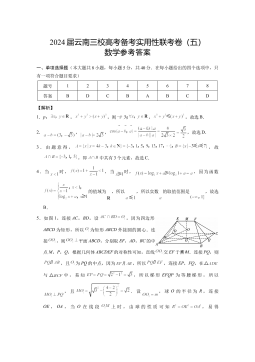
2024届云南三校高考备考实用性联考卷(五)数学-答案和解析-2022-2023学年七年级数学下册同步精品课堂(北师大版)
 2025-01-25 101
 -
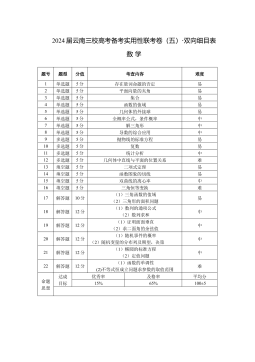
2024届云南三校高考备考实用性联考卷(五)数学 -双向细目表-2022-2023学年七年级数学下册同步精品课堂(北师大版)
 2025-01-25 109
作者:envi
分类:分省
价格:3知币
属性:14 页
大小:78.57KB
格式:DOCX
时间:2024-12-11
作者详情

相关内容
-
《2022-2023学年高二化学同步精品课堂(人教版选修4)》1.1.3 中和反应的反应热及其测量(解析版)
分类:高中
时间:2025-05-15
标签:无
格式:DOCX
价格:3 知币
-
《2022-2023学年高二化学同步精品课堂(人教版选修4)》1.1.2 热化学方程式(原卷版)
分类:高中
时间:2025-05-15
标签:无
格式:DOCX
价格:3 知币
-
《2022-2023学年高二化学同步精品课堂(人教版选修4)》1.1.2 热化学方程式(解析版)
分类:高中
时间:2025-05-15
标签:无
格式:DOCX
价格:3 知币
-
《2022-2023学年高二化学同步精品课堂(人教版选修4)》1.1.1 焓变 反应热(解析版)
分类:高中
时间:2025-05-15
标签:无
格式:DOCX
价格:3 知币
-
《2022-2023学年高一化学同步课时核心考点讲与练(人教2019必修第一册)》课时02 分散系及其分类(精练)(原卷版)
分类:高中
时间:2025-05-15
标签:无
格式:DOCX
价格:3 知币


