
Unit 2 Wildlife Protection易错综合练习-2022-2023学年高一英语必修第二册单元重难点易错题精练(人教版2019)

Unit 2 Wildlife Protection 单元综合检测
(考试时间:120 分钟 试卷满分:150 分)
注意事项:
1.本试卷分第Ⅰ卷(选择题)和第Ⅱ卷(非选择题)两部分。答卷前,考生务必将自己的姓名、准
考证号填写在答题卡上。
2.回答第Ⅰ卷时,选出每小题答案后,用 2B 铅笔把答题卡上对应题目的答案标号涂黑。如需改动,
用橡皮擦干净后,再选涂其他答案标号。写在本试卷上无效。
3.回答第Ⅱ卷时,将答案写在答题卡上。写在本试卷上无效。
4.考试结束后,将本试卷和答题卡一并交回。
第一部分 听力(共 30 分,略)
第二部分 阅读(共两节,满分 50 分)
第一节(共 15 小题;每小题 2.5 分,满分 37.5 分)
阅读下列短文,从每题所给的 A、B、C、D四个选项中选出最佳选项。
A
Did you know that birds could be “property owners”, too? In spring, the male robin ( 知更鸟) looks for a
place to build a nest. A tree near a green lawn ( 草坪)th at has many worms (虫子) suits him best. When he finds
the right place, he sings loudly. He tells other birds that this place is his property.
At the same time, other birds are choosing places for their nests. A robin does not mind if swallows nest
nearby because swallows eat insects. They leave his worms alone. But other robins are different. They would eat
the worm supply he needs for his own family.
When another male robin comes near, the robin owner sings to warn him away. The property owner looks
cross and fierce (凶猛的).He raises his head feathers and holds his tail high. If the owner cannot frighten away the
new robin, he attacks. The two fight until one is the winner. The new bird often gives up and flies away. So the
first bird has defended his property. He now has the right to build a nest in the place.
1.The male robin looks for a place to build a nest ________.
A.near swallows B.near other male robins
C.near a lawn with worms D.in the woods
2.The story does not say so, but it makes you think that robins ________.
A.drive away all the other birds B.do not care where they build their nests
C.are careful when choosing a place to nest D.are not afraid of other birds
3.On the whole, this story is about ________.
A.what robins eat B.robins finding a nesting place
C.robins finding friends D.how robins live with swallows
B
Birds can fill any spring or summer day with music: All you have to do is opening your window to hear
crows “caw”, killdears call “ kill-deah! kill-deah!” and chickadees sing “ chickadee-dee-dee”.
But come back an hour later, and you'll still hear them singing the same song, repeatedly ( 重复地). That’s
because they’re hard at work. These singers are usually male (男性的), and are singing their hearts out to guard
their territory (领地) and attract (吸引) a mate (配偶).
On the territorial front, the singers say, “This is my area and I’m letting everyone else, especially every other
male in the area, know that this is my space.”
Other animals mark their territory by leaving their smell everywhere. Even people mark areas with fences
(栅栏). But birds don’t do it that way, they will sing . And they will sing that song over and over again.
And, hey, if that song attracts a mate in the process, more power to the male. There are nearly 10, 000 species
(物种)of birds in the world, and every species is different, but oftentimes the female is the one that picks the mate.
The males’ songs basically express, “Hey, females! You’re passing by, listen to me because I've got a
beautiful song I’m a healthy male! You should stop by and check me out!”
While the male is singing, he can’t look for food, and his calls make him more easily found by his killers. For
females,it takes a lot of energy to lay eggs and raise young, so she wants to be sure she chooses the right mate
before putting all her eggs in one basket, so to speak.
During the winter, birds often sing fewer notes, or just one note, to each other. These notes are simply a way
to warn the strangers of their territory.
4.What do you know about crows, killdears and chickadees?
A.They are plants. B.They are birds.
C.They are guards. D.They are killers.
5.How do birds mark their territory?
A.By building nests on trees. B.By telling others where food is.
C.By leaving their smell everywhere. D.By singing the same song repeatedly.
6.How many reasons why birds sing?
A.Two. B.Three. C.Four. D.Five.
7.When do birds sing most?
A.In winter. B.In spring or winter. C.In autumn. D.In spring or summer.
C
Natural selection is the process by which one type of animal within a species thrives ( 兴 旺 ) because of
certain characteristics that make it more likely to live than others in its group. The history of the peppered moth
(灰蛾) is an example of the natural selection process.
In nineteenth-century England, certain types of peppered moths were able to better blend ( 融合) into their
surroundings. During that time period, great changes were happening in Great Britain. The Industrial Revolution
was part of this change, and with it came air pollution. Natural selection often takes hundreds or even thousands
of years to occur. For the peppered moth, this process occurred comparatively quickly.
At the beginning of the Industrial Age, most peppered moths in England were light-colored and covered with
black markings, although a few moths had dark-colored wings. Because the light-colored moths blended into the
light-colored bark on the trees, they could not be easily seen by birds that would eat them. As the air grew more
polluted, however, tree trunks became covered with soot ( 煤 烟 ) and became darker. The light-colored moths
became easy for birds to see against the dark tree trunks. Since the dark-colored moths now had the advantage,
their numbers grew. Within 50 years, the peppered moth went from being mostly light-colored to being mostly
dark-colored.
In the twentieth century, the air cleared up, and the peppered moth population changed again. As tree trunks
lightened due to less soot in the air, light-colored moths once again had an advantage. Their numbers increased as
soot levels declined. Depending on their environment, the coloration of the moths helped them to be “naturally
selected” to survive.
8.What do we know about the peppered moth’s natural selection process?
A.It was a good example of environmental protection.
B.The soot levels in England did not affect it.
C.This type of color change was typical for moths.
D.The length of time was unusual.
9.What can we learn from the third paragraph?
A.Both kinds of moths preferred the dark-colored trees.
B.Birds failed to see light-colored moths.
C.There were more light-colored moths than dark-colored moths originally.
D.The color of moths was unimportant.
10.Which would most likely happen if soot darkened England’s trees again?
A.Birds would eat fewer moths.
B.The population of dark-colored moths would increase.
C.Moths would not be able to stay alive.
D.Light-colored moths would disturb people’s life.
11.We can infer from the text that in England ________ .
A.there were always many peppered moths
B.birds preferred to eat dark-colored moths

相关推荐
-
《【学亦有道】中考语文三轮复习全通关(全国通用)》重难点通关03 图文转换(解析版)
 2025-05-19 33
 -
(机构专用)八年级下册语文文言文专题提升学案:《核舟记》复习
 2025-05-19 60
 -
(机构适用)八年级作文拔高专题复习讲义 第8讲 作文拔高立意升格
 2025-05-19 59
 -
(机构适用)八年级作文拔高专题复习讲义 第7讲 如何运用倒叙、插叙的手法
 2025-05-19 46
 -
(机构适用)八年级作文拔高专题复习讲义 第6讲 向名家学写作(毕淑敏)
 2025-05-19 50
 -
(机构适用)八年级作文拔高专题复习讲义 第5讲 记叙文的人物细节描写
 2025-05-19 122
 -
(机构适用)八年级作文拔高专题复习讲义 第4讲 如何积累作文拔高的素材
 2025-05-19 150
 -
(机构适用)八年级作文拔高专题复习讲义 第3讲 向名家学写作(张晓风)
 2025-05-19 83
 -
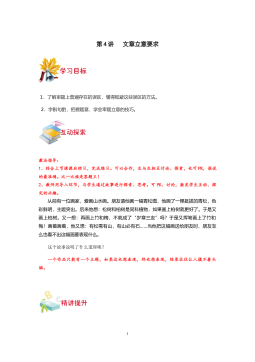
(机构适用)八年级作文拔高专题复习讲义 第2讲 文章审题立意要求
 2025-05-19 144
 -
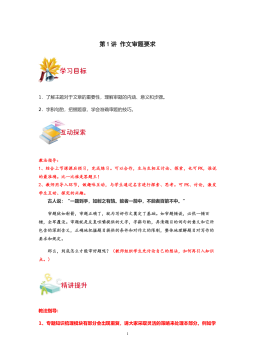
(机构适用)八年级作文拔高专题复习讲义 第1讲 作文拔高审题要求
 2025-05-19 108
作者:envi
分类:高中
价格:3知币
属性:18 页
大小:50.61KB
格式:DOCX
时间:2025-05-08
作者详情

相关内容
-
(机构适用)八年级作文拔高专题复习讲义 第5讲 记叙文的人物细节描写
分类:初中
时间:2025-05-19
标签:无
格式:DOCX
价格:3 知币
-
(机构适用)八年级作文拔高专题复习讲义 第4讲 如何积累作文拔高的素材
分类:初中
时间:2025-05-19
标签:无
格式:DOCX
价格:3 知币
-
(机构适用)八年级作文拔高专题复习讲义 第3讲 向名家学写作(张晓风)
分类:初中
时间:2025-05-19
标签:无
格式:DOCX
价格:3 知币
-
(机构适用)八年级作文拔高专题复习讲义 第2讲 文章审题立意要求
分类:初中
时间:2025-05-19
标签:无
格式:DOCX
价格:3 知币
-
(机构适用)八年级作文拔高专题复习讲义 第1讲 作文拔高审题要求
分类:初中
时间:2025-05-19
标签:无
格式:DOCX
价格:3 知币


